
Michael E. Smith & Ian Cheng Exhibition, Triennale di Milano, Poster by Mousse Magazine, 2014.
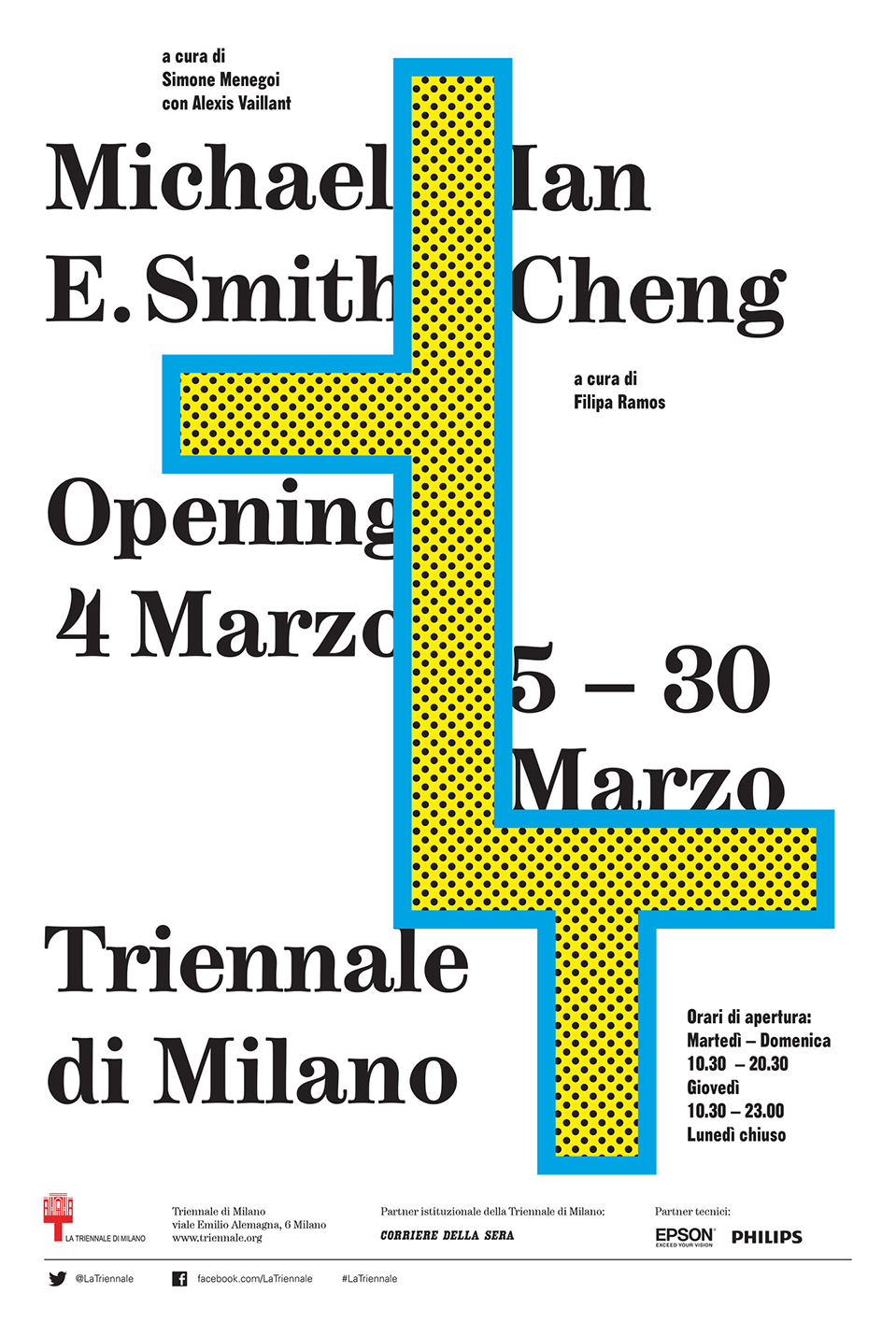
La Triennale di Milano is pleased to present two young American artists, Michael E. Smith and Ian Cheng, appearing for the first time in an Italian institution, with two solo exhibitions that interact and resonate with common themes in the exhibition space. Though they are very different in their forms of expression, both artists adopt a visionary approach, and both of them examine contemporary tensions and imagine possible forms of reaction and resistance, using
mechanisms of opposition and of breaking down the ordinary. Michael E. Smith uses industrial and worthless materials, often altered until no trace of their original purpose remains; Ian Cheng deploys physical bodies in virtual space to explore their potential for action and possible interactions. These reformulations lead to unpredictable processes that invite viewers to reconsider their own ideas of limits and possibilities.
Edoardo Bonaspetti, Curator of Visual Arts and New Media, La Triennale di Milano.
Michael E. Smith
Michael E. Smith (1977) is one of the most interesting American artists of his generation. After studying sculpture at the Yale School of Arts under Jessica Stockholder, among others, he began to exhibit in public and private spaces in the United States and Europe. In 2012, his work was shown in the prestigious Biennial at the Whitney Museum of American Art in New York. Produced in collaboration with CAPC – Musée d’Art Contemporain de Bordeaux, and curated by Simone Menegoi and Alexis Vaillant, chief curator at CAPC, the exhibition is a totally reformulated version of the solo display that Smith has just put on in the Bordeaux museum. In particular, the Italian exhibition differs from the one in France in that it shows a series of new works specially created for the occasion, including one of the artist’s largest-ever installations, the main element of which is a garage shutter.
Smith creates small paintings with rough surfaces, videos that portray fragments of run-down urban landscapes, animals in
captivity, and gestures that appear to be part of incomprehensible rituals, but especially he makes sculptures, his best known and most characteristic works. Created from a range of materials which might include almost anything, from synthetic resin to used clothes, animal bones and bits of household appliances, Smith’s sculptures are generally fairly small objects but always with an intense, disturbing presence. Their shapes and dimensions often recall those of human limbs, and the materials they are made of frequently show signs of ageing, of wear and tear, and of vandalism. The use of broken-down objects and animal parts conjures up post-apocalyptic scenarios. The way the artist displays them is just as intense as the works themselves. Even though there are always only a few of them and they are isolated from each other, the works are rarely placed at the centre of the rooms. They are usually relegated to the corners, halfconcealed behind functional elements such as radiators or pipes, or even hanging from the ceiling. Critics have compared them to animals lying in wait or in hiding, and they have a symbiotic relationship with the architecture of the exhibition space. The artist never creates the same display twice and the exhibition at La Triennale is no exception to this rule. The arrangement of the works is completely different from the one at CAPC in Bordeaux, for it is specially designed for the characteristics of the premises in Milan, and at the moment it is not possible to say what it will be like. The same goes for the new works that will be on show: the artist will make them on the spot while setting up the exhibition. Smith also pays particular attention to the lighting conditions of his exhibitions. Whether by removing all the lamps, thus leaving the space at the mercy of the changing conditions of natural light, or by turning the artificial lighting full on, transforming the halls of a museum into a dazzling white limbo, Smith always creates a particular atmosphere through his lighting effects. For the La Triennale exhibition, the artist has chosen to keep all natural light out of the space, replacing the incandescent bulbs with fluorescent tubes with a much colder tone. Smith’s artistic imagination has its roots in suburban and provincial America, impoverished by the economic crisis and often sorely put to the test by the effects of climate change. In particular, he is deeply attached to his home town, Detroit, one of the most striking examples of what are referred to as “shrinking cities”, which, whether for economic or other reasons, implode on themselves. After a period of radical de-industrialisation, and after shedding more than half its population since it peaked in the 1950s, Detroit is now mostly a wasteland of factories in ruins and abandoned houses. As the American critic Chris Sharp has written, it offers “a disturbingly convincing sneak peek of the end of the world”. This is the setting in which Smith’s work has taken shape and it is from here that – sometimes quite literally – he takes the objects, materials and images he uses for his works.
Michael E. Smith’s art reflects the preoccupations and anxieties of our age, but his underlying gloominess is anything but monolithic. His work does not just talk to us of adversity, but also of the tenacity of human resistance to it. He may let himself go to flickers of humour or to unexpected heights of lyricism, as we see in Untitled (2013), one of the works in the exhibition: a multiple video projection in which a very brief shot of Miles Davis in concert is slowed down and manipulated until it becomes an almost abstract sequence of mysterious beauty.
Ian Cheng
Art is not a thing in the world.
It is a perception invented inside of us using things in the world.
Ian Cheng presents a series of live computer simulations that dynamically change forever, never to repeat themselves.
One simulation features a collection of things.
One simulation features an ecosystem.
One simulation features an ecosystem of the mind.
And one video features a choreography of unconscious human behavior.
These artworks come from the question: what does it feel like to surf through the chaos and uncertainty inside and outside of us?
We can develop this feeling within art.
Curator’s statement:
Ian Cheng is interested in the conditions of mutation and the capacity of humans to relate to complex nonlinear change. The processes of change happening at all scales in the external world become continuous with the neurological and psychosocial shifts happening within the human mind. What mental models are needed to grasp this complexity? And what forms are needed to play with it?
For his first solo exhibition in Italy, the artist presents a series of live computer simulations and an animated video, all set within a unique installation that considers the specific environmental characteristics of the Triennale and its local mode of presentation. Mutating the plinth to cartoonish proportions, Cheng’s installation functions simultaneously as support, display, mixing structure, and ziggurat. Visitors are invited to observe the works individually or experience them as different disruptive organisms within a single emergent body.
The elements that appear in the various works resemble cartoons of mundane things: humans, animals, plants, planets, rocks, blocks, cells. For Cheng, cartoons are a concrete expression of cognitive mental models. They are literal simplifications of reality that allow the mind to relate to selective dimensions of a complex and ever-changing world outside and inside us. The animations and simulations on display take these simplified models as a starting point.
But nothing remains static. Imbued with basic properties and algorithms, Cheng’s forms produce emergent unscripted behaviors that continuously adjourn a climax and delay a final resting state. There is a relentless sense of aliveness and loss of control. This feeling comes from the fact that every observed moment is the result of a unique, unrepeatable combinatorial instance, which is forever lost after its appearance. Seen as part or whole – installation, works, or elements – they stretch notions of improvisation and the performative into a flux of time that knows neither beginning nor end.
March 5th- 30th 2014
Michael E. Smith, curated by Simone Menegoi and Alexis Vaillant
Ian Cheng, curated by Filipa Ramos